Project Overview
As Lead Product Designer, I joined a complex enterprise program nearing launch, leading design across 9 cross-functional team members while establishing design operations and improving collaboration between Product, Engineering and Design.
Business Context & Product Opportunity
Enterprise customers increasingly expect self-service network management with the speed and flexibility of cloud platforms. Telstra developed ANC to enable customers to manage their networks digitally, reducing reliance on manual provisioning while giving businesses greater control over their connectivity.
The Challenge & Opportunity
When I joined ANC, the product had already been in development for several years without reaching market. Multiple squads were designing independently, the experience lacked consistency, and the complexity of the platform made alignment increasingly difficult as launch approached. My role was to bring structure to the design process, improve collaboration across teams, and help deliver a cohesive experience customers could trust. Without stronger design leadership, there was a risk the product would launch with inconsistent experiences across customer journeys.
My Role
As Lead Product Designer, I was responsible for defining and delivering the customer experience across ANC. I partnered with Product, Engineering and business stakeholders across multiple squads, providing design direction, establishing UX standards, facilitating design critiques, and supporting the team through to launch.
Design Leadership & Strategic Decisions
I joined a complex enterprise product nearing launch, bringing design leadership and structure to the program. I helped align cross-functional teams, improve design delivery, and support the successful launch of ANC.
To maintain alignment across multiple squads, I facilitated weekly design forums where Product, Engineering, and Design reviewed progress, discussed trade-offs, and resolved disagreements early. When competing stakeholder priorities emerged, I advocated for validating assumptions through user testing wherever possible, ensuring design decisions were grounded in customer evidence rather than opinion.
I worked closely with Product Owners to influence the roadmap, prioritising features that addressed the most significant customer pain points while balancing technical and business constraints. Where proposed features didn't provide clear customer or business value, I recommended deferring them until there was stronger evidence to justify investment.
As launch approached, I identified inconsistencies across the experience and introduced regular design reviews to improve collaboration between designers and engineers. This created a more consistent handover process, increased delivery confidence, and helped ensure a cohesive product experience.
Discovery & Research
To better understand the problem space, I interviewed Telstra Partners, who interact with customers daily and could provide valuable insights into their pain points. Direct customer research was difficult due to recruitment challenges, so partner interviews, combined with existing journey maps, helped validate that we were solving the right problems.
One of the biggest surprises was finding out that partners create 10s sometimes more versions of a solution before presenting it to customers, and hence their need for speed and flexibility.
To build a more complete picture, I also analysed support tickets and product analytics supplied by the product team to identify recurring issues and opportunities at scale. Once the key user journeys had been defined, I facilitated usability testing to validate the proposed solutions, gather feedback, and iteratively refine the experience before delivery.
Insights & Experience Strategy
Research revealed that partners rarely create a network solution in a single attempt. Instead, they typically iterate through 10 or more versions before arriving at a final design, with cost estimation being the primary decision-making factor throughout the process. We also learned that account managers relied heavily on visual representations of customer networks, but that large solutions became difficult to navigate, highlighting the need for different ways to view information.
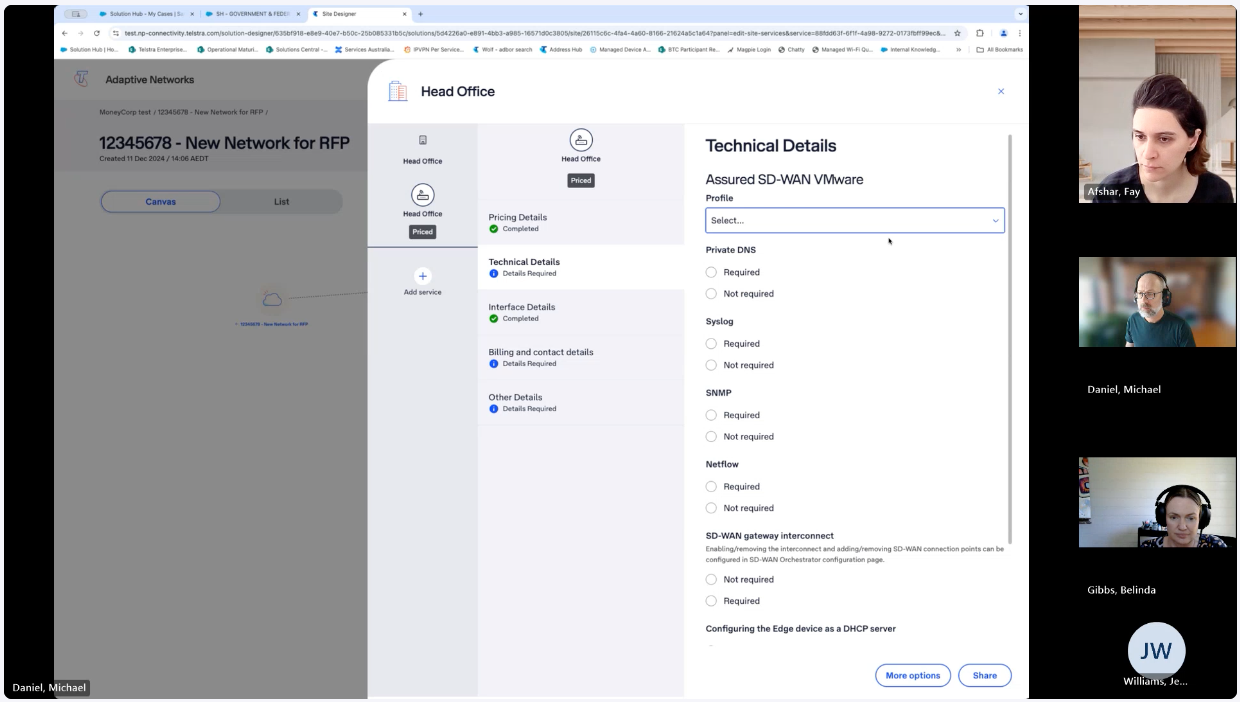
A screenshot of research I facilitated with Partners.
Exploring Solutions
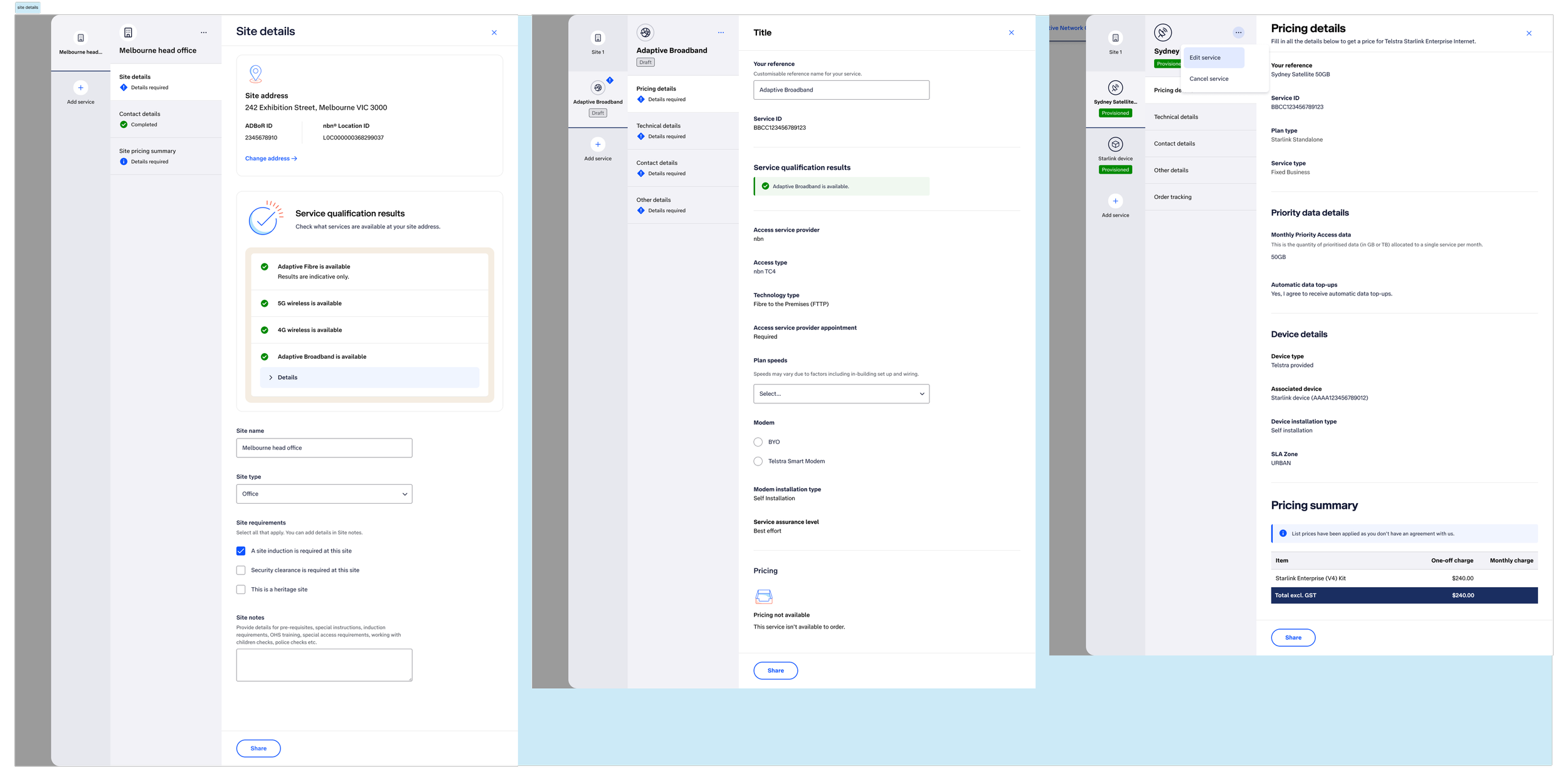
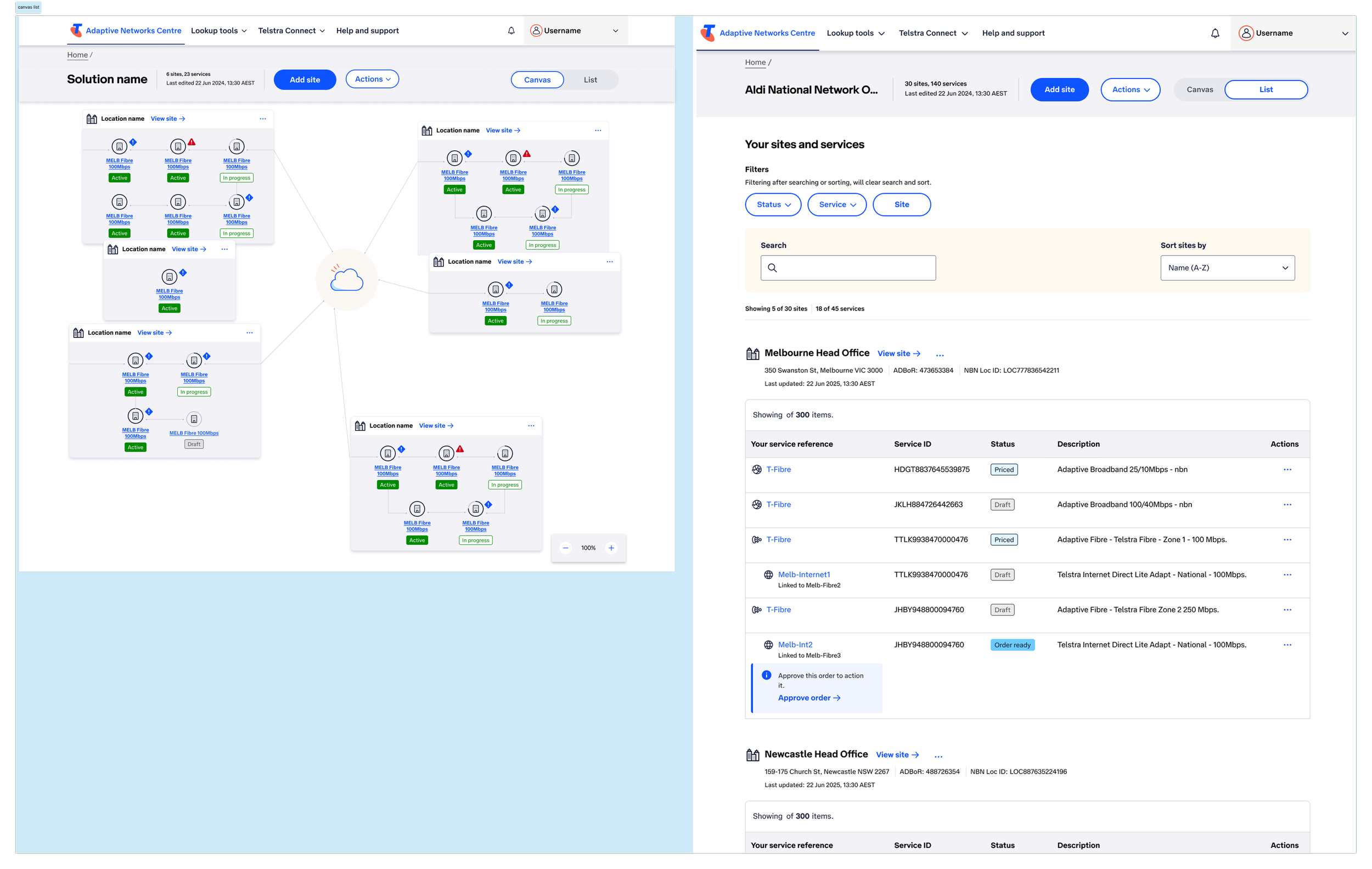
We explored ways to remove unnecessary friction from the quoting workflow by allowing partners to estimate pricing before entering detailed site information. We also investigated how to support both small and complex network designs by providing complementary Canvas and List views, allowing users to switch between visual and structured representations depending on the size and complexity of the solution.
Experience Design & Delivery
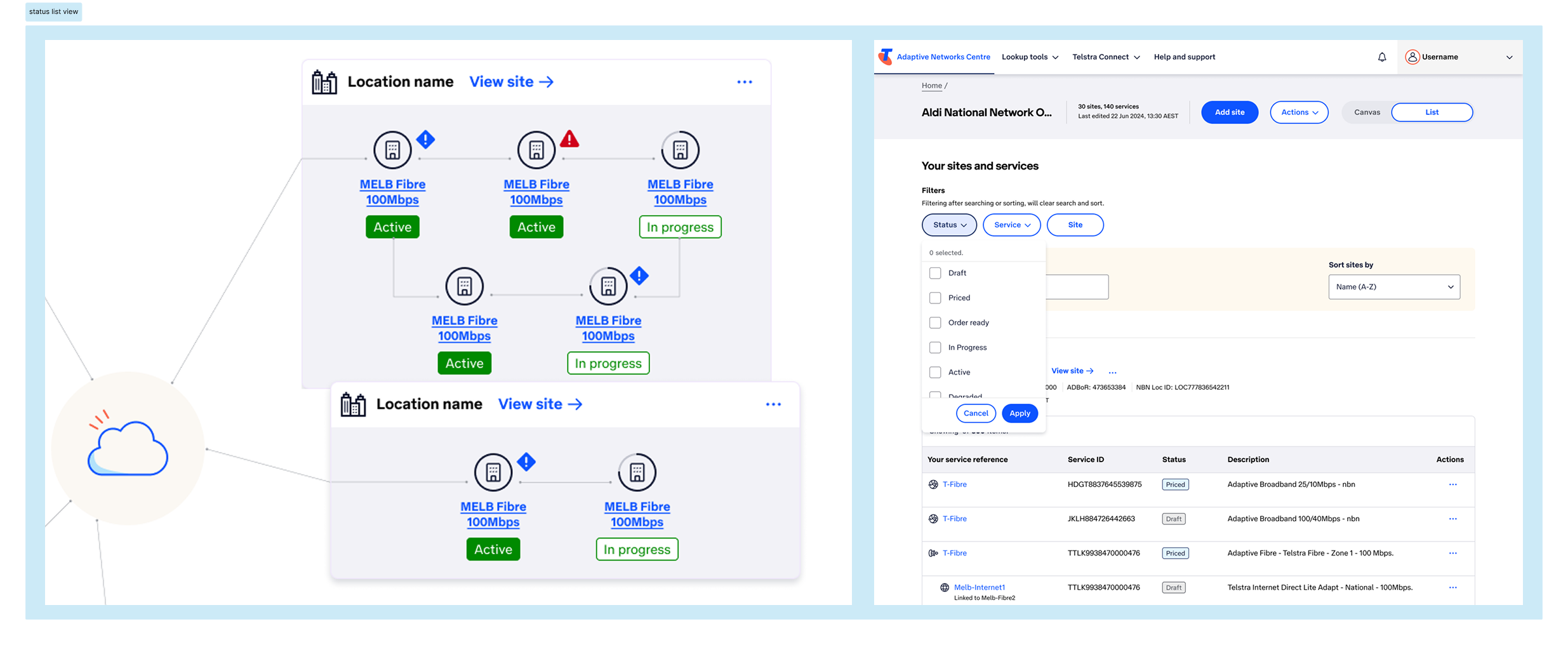
The final ANC experience enabled partners to generate price estimates earlier in the workflow, significantly reducing the effort required when iterating through multiple solution options. We also enhanced the network management experience by surfacing key site statuses directly on the Canvas and introducing a List view for larger solutions, improving usability without sacrificing the visual overview valued by account managers.
Impact & Outcomes
The launch of ANC has improved user satisfaction (for partners, sales and customers) as well as speeding up delivery of services to the market. Customers can now procure networking solutions, including;
Accelerated fibre and internet activation from 10 business days to under 3 hours, a speed improvement of 26x.
Reduced broadband procurement times from 3 business days to less than 4 hours, a speed improvement of 6x.
Partners and customers can now co-design solutions in ANC, never before possible.
Contracting and pricing which took days previously is now fully automated.
In 2025 ANC became the Runner up for Gartner Eye on Innovation Awards.
Some quotes from users:
"...[this] is fantastic, and I know there's a roadmap and it's a long-term goal, but.../ think these are fantastic improvements in the whole experience" - Telstra Partner
"What I really love...is I'm able to order upgrades and changes [myself] to the service if / require that, as / look to expand and grow my business" - Telstra Mid Market Customer
Reflection
Looking back, I would place greater emphasis on defining clear roles and responsibilities during user research. While several designers initially volunteered to help facilitate sessions and take notes, expectations around participation weren't clearly established. As a result, support during the research was inconsistent. In future, I would clearly communicate responsibilities upfront so everyone understands their role and is fully engaged throughout the sessions.
I would also introduce a formal UI walkthrough earlier in the sprint. I observed that the level of design handover varied between designers—some provided detailed walkthroughs while others relied more heavily on documentation alone. This inconsistency led to developers raising questions later that could have been addressed during handover. Establishing a consistent walkthrough process would improve alignment, reduce ambiguity, and create a smoother transition from design to development.